


Recommended Products
- Ceramic fiber board for wall-hung boilers and gas boiler
 Temperature Grade: 1260°C(2300°F), 1400°C(2550°F), 1430°C(2600°F)
CCEWOOL Ceramic Fiber Board for wall-hung and gas boilers is distinguished by its lightweight construction and high compressive strength. Manufactured via automated, continuous processes with a small addition of high-purity aluminosilicate fiber binder, it offers precise large dimensions, superior flatness, excellent strength, low weight, outstanding thermal-shock resistance, and anti-spalling properties.
- Bio Soluble Fiber Blanket
 CCEWOOL Bio Soluble (Low Biopersistent) Fiber Blanket is made from alkaline earth silicate and is a calcium-magnesium insulating fiber. It is referred to as a soluble fiber because it has some solubility in bodily fluids. The introduction of MgO and CaO in soluble fibers enhances their flexibility, elasticity, and provides excellent thermal and mechanical performance.
- Ceramic fiber blanket
 Temperature Grade: 1100°C(2012°F), 1260°C(2300°F), 1400°C(2552°F), 1430°C(2600°F)
CCEWOOL Ceramic Fiber Blanket is a new type of fire-resistant insulation materials in white and tidy size, with integrated fire resistance, heat separation and thermal insulation functions, containing no any binding agent. All CCEWOOL Ceramic Fiber Blankets are made though spun fiber production, the working temperature is from 1100°C to 1430°C.
- Ceramic Fiber Cloth
 CCEWOOL Ceramic Fiber Cloth is a woven fabric made from our high quality ceramic fiber yarn. It is strong, lightweight, flexible, and available in a wide variety of thicknesses, widths and densities. Ceramic cloth contain absolute amount of binder material which is normally burned at lower temperature and does not affect the insulation property.
- Ultrathin 6mm Ceramic fibre blanket
 Temperature Grade: 1260°C(2300°F), 1400°C(2552°F), 1430°C(2600°F)
CCEWOOL Untral-thin Ceramic Fibre Blanket is a new type of fire-resistant insulation materials in white and tidy size, with integrated fire resistance, heat separation and thermal insulation functions, containing no any binding agent. All CCEWOOL Ceramic Fibre Ultra-thin Blankets are made though spun fiber production, which is widely used in various sectors of refractory, insulation.
- DJM Insulating brick
 Temperature Grade: 2300°F(1260°C), 2600°F(1430°C), 2800°F(1540°C), 3000°F(1650°C), 3200°F(1760°C)
CCEFIRE DJM Series Mullite insulation brick is a new type of refractory material, which can directly contact with fire, characterized with high temperature resistance, lightweight, low thermal conductivity, good energy saving effect.
- Ceramic Fiber Tape
 Ceramic Fiber Tapes that are fabricated using high quality ceramic fiber yarn and are reinforced with fiberglass filament & ss wire.
- Ceramic fiber square rope
 Ceramic Fiber Rope is a length of fibers, twisted or braided together to improve strength for pulling & connecting and can also be called as fibril or filament. We provide round rope, square rope and twisted rope. Both kind has two type, glass filament reinforced and stainless stainless steel reinforced.
Top articles
- How much does insulation brick insulate?
- Does mullite insulation brick make good insulation?
- What is the difference between insulating fire brick and fire brick?
- Why are more boilers choosing CCEWOOL thermal ceramics modules for insulation?
- What is the lifespan of ceramic fiber modules?
- How CCEWOOL Refractory Ceramic Fiber Module Helps Metallurgical Furnaces Cut Energy Use and Maintenance Needs?
- Why More Aluminum Plants Are Choosing CCEWOOL Refractory Fiber Board for Tundish and Electrolytic Cell Insulation?
- Why Choose CCEWOOL Ceramic Insulation Board for Petrochemical Furnace Hot-Face Linings?
- What is Ceramic Fiber Back-lining Board Used For?
- What happens if ceramic fiber board gets wet?
Latest articles
- Ceramic Insulation Board - CCEWOOL
- How much does insulation brick insulate?
- Refractory Ceramic Bulk Fiber - CCEWOOL
- Does mullite insulation brick make good insulation?
- Ceramic Blanket - CCEWOOL
- What is the difference between insulating fire brick and fire brick?
- Superwool Blanket - CCEWOOL
- Why are more boilers choosing CCEWOOL thermal ceramics modules for insulation?
- Ceramic Fiber Blankets - CCEWOOL
- What is the lifespan of ceramic fiber modules?
Your browsing history

How much does insulation brick insulate?
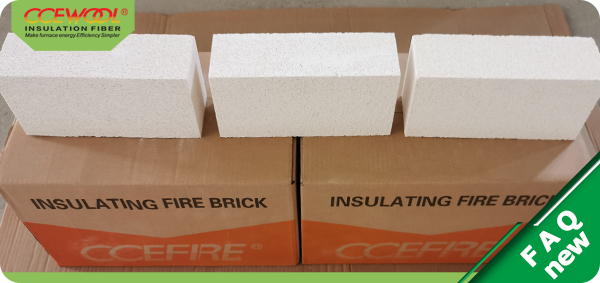
In high-temperature industrial production, the efficiency of furnaces, heat-treatment kilns, and heating equipment largely depends on the insulation materials used. Insulating Fire Bricks (IFB) are one of the key materials. Beyond withstanding heat and providing structural support, their most important function is reducing heat transfer, minimizing energy loss, and improving overall furnace efficiency.
Thermal Conductivity and Insulation Performance
The core measure of insulation performance is thermal conductivity.
At around 1000°C, dense refractory bricks usually have a thermal conductivity above 1.0 W/m·K, while high-quality insulation bricks can be as low as 0.2–0.4 W/m·K.
This means, at the same thickness, insulation bricks significantly reduce heat transfer, lowering the furnace shell’s external temperature and improving the working environment.
Lightweight Structure Advantages
Insulation bricks are typically produced using foaming agents or combustible additives, forming numerous fine closed pores inside the brick:
Lightweight: Bulk density is usually 0.6–1.2 g/cm3, only half or even less than that of dense refractory bricks, reducing load on furnace steel structures.
Enhanced insulation: The enclosed pores trap air, which has very low thermal conductivity, further improving insulation.
Easy installation: Lightweight properties simplify handling and installation, improving construction efficiency.
Practical Energy-Saving Effects
In glass kilns, petrochemical cracking furnaces, and steel heat-treatment furnaces, insulation bricks are commonly used as backing layers, bringing clear benefits:
Reduced heat loss, lowering fuel consumption.
Improved energy utilization, shortening heating times.
Extended lining life, reducing maintenance frequency and downtime costs.
Studies show that with proper application, furnace systems using insulation bricks can improve overall thermal efficiency by 5%–10%, delivering long-term energy savings.
So, how much do insulation bricks insulate? The answer is: under high-temperature conditions, they reduce heat transfer several times over, significantly enhancing furnace insulation and efficiency. With their low thermal conductivity, lightweight design, and stability, insulation bricks are indispensable energy-saving materials in modern high-temperature industries.
leave message to apply
- Your Name :*
- Company Name:*
- Your E-mail:*
- Remarks:*


